Champion tracking finds the people who used your product at a customer and have since moved to a new company. Then it reaches them there.
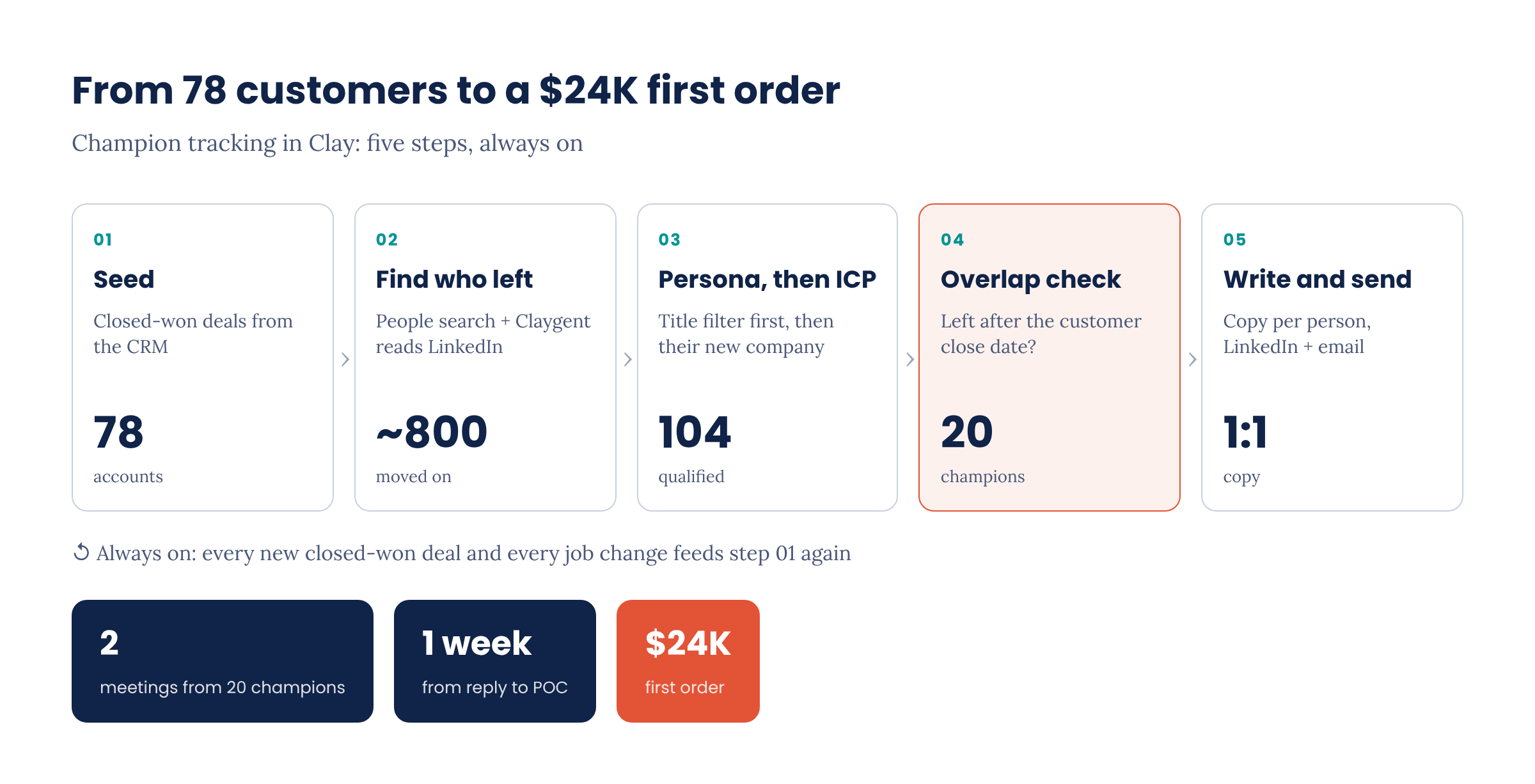
They are the warmest list there is. They already know the product works, so there's no trust gap to close. We built this for a client: from 78 customer accounts it found 20 real champions, which turned into 2 meetings and a $24K first order, the first deal from that outbound program. One week from reply to POC.
Most companies have a list of their customers. Almost nobody has a list of the people at those customers who actually used the product, and fewer still know where those people work now. That gap is the whole opportunity.
A campaign runs once. A system keeps running, and when results drop you can see which step broke. This one has five steps.
- 01
Seed from closed-won
- Export your closed-won deals from the CRM into Clay: company name, domain and close date
- Keep the close date: you'll need it in step 4
- In our case, that was 78 accounts from HubSpot
- 02
Find who left
- Run a Clay people search on those company domains with past experience included, filtered to the job titles that actually used the product. For our client that was IT and procurement
- People search tells you someone worked at a customer. It doesn't reliably tell you whether they left, or when. So pair it with a Claygent that opens each LinkedIn profile, reads only the Experience section and decides
- The old role has an end date: left
- No end date, but a newer full-time job at another company: left (the new job's start date becomes the end date)
- The old company is their only current job: stayed
- The profile can't be opened: skip, never guess
- Inputs: LinkedIn URL, name, old company domain. Outputs: left or not, and the end date. A light model is enough for this (we used GPT-4o mini)
- The second rule matters more than it looks: people forget to close old roles on LinkedIn, so the newer job wins. That rule alone rescued a lot of people
- About 800 people had moved on to a company that isn't already a customer
- 03
Persona first, then ICP
- Run the persona check first. It only reads the job title, so it's cheap, and it drops recruiters, pre-sales and other wrong roles before you pay to enrich their companies
- Then check their new company against your ICP, loosened on purpose. A warm list earns a wider net
- For our client: any tech company, 150 employees instead of 300, at least two countries
- That left 104
- 04
The overlap check
- Worked there is not the same as used it. Check the dates
- Compare two columns side by side: the date the person left (from the Claygent in step 2) and the date their old company became a customer (the close date from step 1)
- Left after the close date: they were there while the company used the product. Champion
- Left before the close date: they know the logo, not the product. Out
- This step took the list from 25 to 20. It's the step that matters most
- 05
Write and send
- Write the copy per person, not as a merge template, and send through LinkedIn and email
- The structure is four lines. The personalization only exists to set up the value prop
- Every token is a Clay column. old_company: the deal name in your CRM. personalization: Clay enrichment on the new company, plus the person's LinkedIn headline. value_prop and cta: picked by persona
- A real example: their new company had offices from Berlin to Chengdu, so getting a laptop to a new starter is its own project. At their old company, our client handled exactly that
- Use a fact, don't recite it. One concrete detail beats a paragraph of research
- Don't bet copy on AI-generated counts. Name real cities, not "you're in 14 countries"
Subject: from {{old_company}} {{first_name}}, you'll know us from {{old_company}}. {{personalization}}: one fact about {{new_company}} today that creates the problem. At {{old_company}} we {{value_prop}}: the same problem, already solved for them. {{cta}}: a small first step. - 06
The result
- A champion replied positively on LinkedIn. A week later their new company had started a POC
- Then the first order came in: $24K, the first deal from the outbound program
- Out of 20 champions, 2 booked meetings
- Why it moved so fast: they had no solution in place, and the person bringing us in already knew the product worked
- 07
Three things to do on day one
- Check the dates. Were they still there when the company became a customer? If not, they never used it. Check before you write a single line of copy
- Re-run your blocklist before every send, closed-won included. We almost prospected a company that had signed the night before
- Make it always on. Deals close and people change jobs every week. Every new closed-won deal and every job change feeds step 1 again. Re-run it, don't rebuild it
- 08
Build it yourself
- Everything above runs inside Clay: the CRM import, the people search, the Claygent and the date checks
- Start with your last 12 months of closed-won deals and the two or three job titles that actually use your product
Want one play like this in your inbox every week? Subscribe to Revenue Systems Decoded.
Next playbookThe Prospecting Playbook